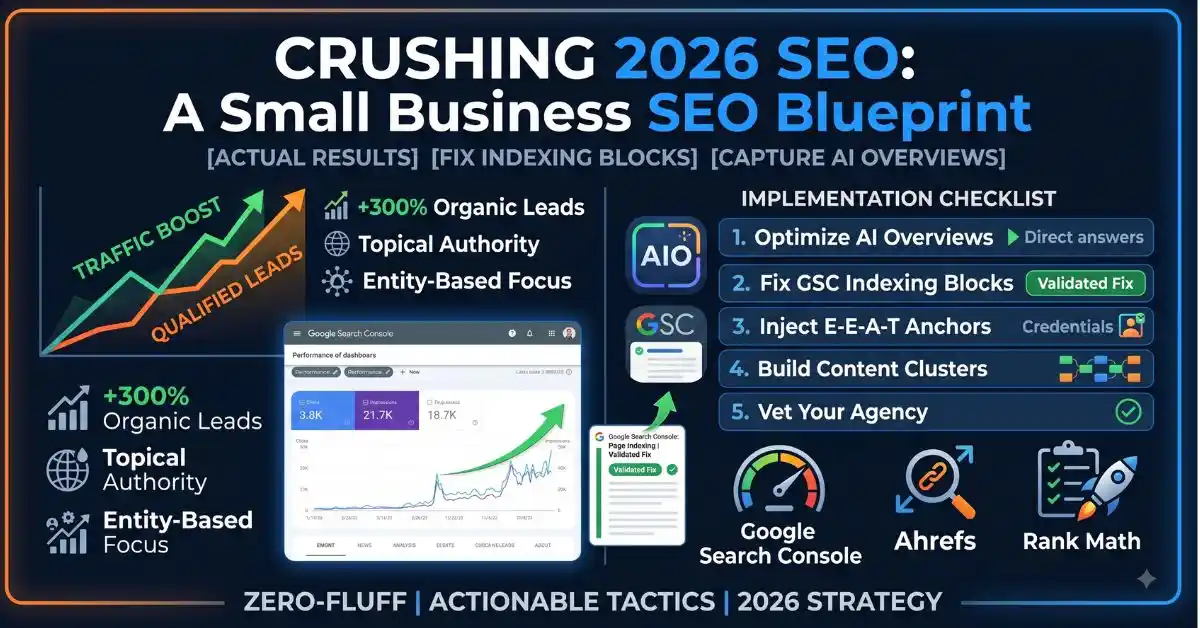
Struggling to rank your local site while AI Overviews steal all your organic clicks? If you are tired of burning cash on a small business seo service that delivers automated PDF reports instead of actual revenue, you are in the right place.
Google’s algorithm has radically shifted. Traditional blue links are dead.
To survive the 2026 Answer Engine Optimization (AEO) rollout, you must pivot to entity-based writing, hyper-local trust signals, and flawless technical health. Pumping out generic keyword-stuffed pages will get your site ignored by AI crawlers.
This guide skips the beginner theory. Below is the exact, zero-fluff blueprint to fix your indexing blocks, establish topical authority, and scale your traffic.
Step 1: Why a Standard Small Business SEO Service Won’t Work in 2026
If you hire a legacy small business seo service, they will likely focus on keyword density and 500-word blog posts. That strategy is dead.
Google now prioritizes Generative Engine Optimization (GEO). AI systems extract standalone statements and first-person experiences to build AI Overviews.
If your content lacks verifiable data, AI crawlers will skip it. You need a strategy built on hyper-local signals, strict E-E-A-T, and uncompromised technical performance.
Step 2: Vetting Small Business SEO Services (The E-E-A-T Test)
Most small business seo services outsource content to cheap AI writers. Google’s 2026 algorithm actively demotes generic, unverified text.
Before signing a contract, force the agency to pass the E-E-A-T test. Ask them exactly how they plan to inject real-world experience into your pages.
- Do they use first-person language (“Based on our testing…”)?
- Will they add custom visuals or original data to every post?
- Do they include credentialed author bios linking out to LinkedIn profiles?
🎯 Why this works: AI search engines look for “information gain.” They prioritize original data and human-led experiences that algorithmic scrapers cannot invent.
Step 3: What SEO Companies for Small Business Hide About AI Search
Many seo companies for small business promise massive traffic spikes, but they hide the reality of zero-click searches.
AI Overviews now dominate informational queries. Users get their answers directly on the search results page without ever clicking your link.
Agencies selling you on pure traffic volume are lying. The real metric to track in 2026 is Qualified Lead Conversion, not just raw clicks from top-of-funnel queries.
Step 4: Optimize for AI Overviews (Zero-Click Domination)
To survive zero-click environments, you must format your content so Answer Engines can easily parse it.
Stop writing long, winding introductions. Use clear, declarative sentences immediately under your headings.
- Write your H2 as a verbatim “People Also Ask” question.
- Provide the exact answer in a bolded list or short paragraph right below it.
- Back it up with a primary source citation.
🎯 Why this works: AI models extract short, standalone statements. Giving them a clean, structured summary increases your chances of being cited in the AI Overview block.
Step 5: The Technical Stack Used by the Best SEO Companies for Small Business
You don’t need 50 different plugins. The best seo companies for small business rely on a lean, high-performance tech stack.
Here is what you actually need:
- Google Search Console for monitoring indexation. 👉 [ search.google.com ]
- Ahrefs for backlink gap analysis and competitor research. 👉 [ ahrefs.com ]
- Rank Math SEO for managing Schema markup and on-page optimization. 👉 [ rankmath.com ]
A lean stack prevents code bloat and keeps your Core Web Vitals in the green—a non-negotiable baseline for 2026.
Step 6: Fixing Indexing Blocks in Google Search Console
You can have the best content in the world, but if Google can’t crawl it, you will never rank.
Here is exactly how to fix indexing blocks using GSC:
- Open GSC and navigate to the left sidebar.
- Click on Indexing, then click on Pages.
- Scroll down to the Why pages aren’t indexed table.
- Click on Excluded by ‘noindex’ tag to see which URLs are being blocked.
- Remove the accidental ‘noindex’ tag in your SEO plugin (like Rank Math), then return to GSC and click Validate Fix.
🎯 Why this works: Resolving technical errors reclaims wasted Crawl Budget, forcing Googlebot to index your revenue-generating pages instead of getting stuck on broken URLs.
Step 7: In-House vs. Search Engine Optimization Services for Small Business
Should you build a team or hire out?
If you lack the budget for full-time technical SEOs, writers, and link builders, outsourcing to specialized search engine optimization services for small business is your best bet.
However, you must manage them tightly. Force them to audit your pages quarterly using GSC.
Make sure they only refresh the top 20% of your pages that drive actual conversions. “Fake edits” (just changing the publish date) no longer fool Google.
Step 8: Scaling Your Small Business SEO with Content Clusters
Publishing random posts on random topics will not build topical authority. To dominate small business seo locally, you must build content clusters.
- Choose one core pillar topic (e.g., “Commercial Plumbing”).
- Create 15-30 supporting subtopic articles addressing every angle, question, and local variation.
- Interlink all supporting posts back to the main pillar page using descriptive anchor text.
🎯 Why this works: Dense content clusters signal deep topical expertise to Google. It proves you are the absolute authority on the subject, drastically improving your chances of ranking across the entire cluster.
5 Technical SEO FAQs for Small Businesses
Q: Why does Google Search Console say my page is “Discovered – currently not indexed”? A: Google knows your page exists but refused to spend Crawl Budget rendering it. In 2026, this usually means your content lacks unique E-E-A-T signals. Inject first-hand data, upgrade your entity relevance, and request indexing again.
Q: Can I still track traffic if users get their answer from AI Overviews? A: Zero-click searches are notoriously difficult to track. Stop obsessing over raw traffic. Instead, track Qualified Lead Conversions in your CRM and monitor brand-name search volume spikes in GSC.
Q: Do I really need Schema markup for a local service page? A: Yes. Schema markup is the native language of AI Search Engines. Use your SEO plugin to deploy LocalBusiness and FAQPage JSON-LD. This feeds your exact business entities directly to the algorithm.
Q: Why did my local rankings drop after the latest 2026 Core Update? A: You likely got hit by the algorithm’s anti-spam filters. Audit your site for thin, AI-generated content lacking human verification. Check GSC immediately for manual penalties or spikes in 404 errors.
Q: How do I fix a rogue ‘noindex’ tag blocking my revenue pages? A: Go to your WordPress SEO plugin (like Rank Math). Navigate to the specific page’s advanced settings, toggle the robot meta tag from ‘noindex’ to ‘index’, clear your site cache, and validate the fix in GSC.
Conclusion:
Relying on outdated keyword stuffing and automated blog posts is a guaranteed way to flatline your organic traffic in 2026. The algorithm now demands technical perfection, entity-based writing, and strict Answer Engine Optimization.
Whether you execute these tactics in-house or hire a dedicated small business seo service, you must demand a strategy anchored in E-E-A-T and actual revenue generation. Stop settling for PDF reports filled with vanity metrics. Clear your indexing blocks, structure your content for AI overviews, and start dominating your local market.