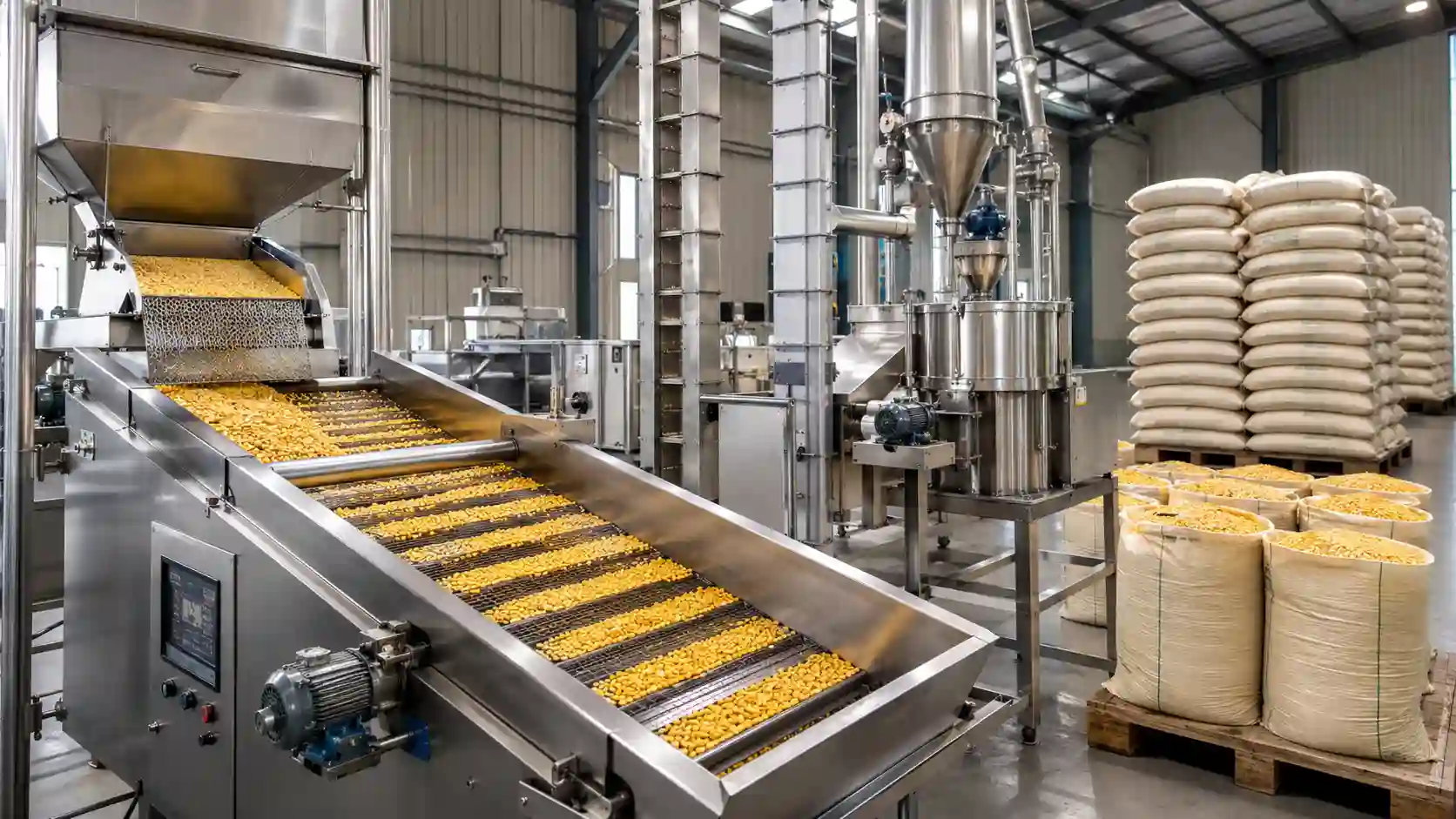
India is the world’s largest producer, consumer, and importer of pulses (dal), with over 70% of the population relying on them as a primary source of dietary protein. Despite massive domestic cultivation, a significant bottleneck exists in the agricultural supply chain: the processing stage. Large-scale regional dal mills incur heavy logistics costs, resulting in higher market prices and post-harvest losses for local farmers.
Establishing a Mini Dal Mill business bridges this gap. By setting up decentralized, small-scale processing units close to agricultural hubs, small-to-medium enterprise (SME) owners can dramatically cut transportation overheads and supply fresh, unpolished dal directly to regional markets. This guide provides a practical blueprint for launching a highly profitable mini dal mill business in India, detailed with infrastructure requirements, exact machinery configurations, capital breakdowns, and licensing guidelines.
1. Step-by-Step Business Setup Blueprint
Launching a mini dal mill requires structured micro-planning. Unlike massive industrial mills that process 10 to 50 metric tons (MT) daily, a mini dal mill typically operates at a nimble 1 to 3 MT per day capacity.
Phase 1: Location and Site Selection
To minimize raw material transportation costs, locate your plant within or near an agricultural cluster, specifically close to Agricultural Produce Market Committees (APMCs) or rural pulse-growing zones. Key states producing high volumes of pulses include Madhya Pradesh, Maharashtra, Rajasthan, Uttar Pradesh, and Karnataka. Ensure the site has:
- An all-weather connecting road for heavy commercial vehicles (tempos and trucks).
- A stable electrical grid connection (three-phase supply).
- Proximity to a clean water source for the pulse conditioning/pitting stage.
Phase 2: Space Requirements and Layout Designing
A total area of 1,500 to 2,500 square feet of built-up space is required to operate a 2 MT/day mini dal mill efficiently. The workspace must be segmented to prevent cross-contamination and ensure optimal material flow:
- Raw Material Storage Zone (400–600 sq. ft.): Must be completely dry, moisture-proof, and elevated to prevent rodent infestation.
- Processing & Milling Area (600–800 sq. ft.): Dedicated to the machinery assembly line. This area requires a high ceiling (minimum 12–14 feet) to accommodate bucket elevators and vertical de-husking units.
- Finished Goods & Packaging Station (300–400 sq. ft.): Space for holding polished, graded dal and setting up the automated weighing and sealing machine.
- Drying Yard (500–800 sq. ft.): While mechanical dryers are used, a concrete open sun-drying yard remains highly cost-effective for micro-enterprises during peak seasons.
2. Required Machinery & Equipment
The pulse milling process involves four primary stages: Cleaning/Grading, Pitting/Conditioning, De-husking/Splitting, and Polishing/Packaging. A standard semi-automatic or automatic mini dal mill plant features an integrated setup powered by a 15 to 25 HP three-phase electric motor.
Below is the complete equipment manifest required for a standard 2 MT per day capacity mill:
Core Processing Unit
- Mini Dal Mill Machine (Integrated Unit): Comprises an emery roller for de-husking and a split roller for breaking the pulse into two cotyledons.
- Capacity: 200–300 kg/hour.
- Motor: 7.5 HP to 10 HP.
- Reel Grader / Separator: Removes external foreign matter such as stones, dirt, and chaff, while sorting the raw pulses by size before milling.
- Capacity: 500 kg/hour.
- Dal Polisher: Uses water, oil (edible oil coating), or leather strip friction to impart a clean, marketable shine to the split pulses.
- Capacity: 300 kg/hour.
Material Handling & Auxiliary Systems
- Bucket Elevators (2 Units): Vertically transfer the raw and semi-processed pulses between the grader, pitters, and milling rollers, eliminating intensive manual labor.
- Screw Conveyor & Oil/Water Pitting Mixer: Applies a uniform micro-layer of water or oil to the pulses to loosen the seed coat (husk) before it enters the drying phase.
- Aspiration System / Dust Collector: A centrifugal blower system that sucks away loose husks, powder, and fine dust during the milling process, maintaining clean indoor air quality.
- Pneumatic Packaging Machine: An electronic weigh-filler that packs dal into 1 kg, 5 kg, and 30 kg bags.
3. Investment & Cost Breakdown
The initial financial requirement depends heavily on whether you choose to purchase the land or lease a commercial warehouse space. The breakdown below assumes a leased factory shed to preserve capital for core machinery and raw material procurement.
The following comprehensive capital structure outlines the initial investment needed to establish a 2 Metric Ton per day capacity Mini Dal Mill:
| Investment Head | Description | Estimated Cost (INR) |
| Land & Shed Lease | 3-month security deposit + initial lease for 2,000 sq. ft. area | ₹75,000 – ₹1,20,000 |
| Civil Works & Flooring | Anti-skid concrete flooring, machinery foundations, and dust proofing | ₹1,500,000 – ₹2,00,000 |
| Core Machinery Plant | Integrated Dal Mill, Grader, Polisher, Blowers, and Elevators | ₹4,50,000 – ₹6,50,000 |
| Electrical Infrastructure | 25 HP Three-Phase line installation, transformer fees, and panel boards | ₹1,20,000 – ₹1,80,000 |
| Packaging & Weighing Systems | Semi-automatic pneumatic sealing machine and platform scales | ₹80,000 – ₹1,30,000 |
| Working Capital (Cycle 1) | Raw material procurement (approx. 15-20 tons of raw pulses) and labor | ₹10,00,000 – ₹12,00,000 |
| Pre-operative & Legal Expenses | FSSAI licensing, GST registration, company incorporation, Pollution NOC | ₹30,000 – ₹50,000 |
| Miscellaneous & Contingency | Hand tools, fire safety equipment, bags, stitching machines, emergency cash | ₹50,000 – ₹70,000 |
| TOTAL ESTIMATED CAPITAL | Complete setup to initial commercial production run | ₹19,55,000 – ₹26,00,000 |
4. Licensing, Registrations & Government Subsidies
Food processing is a heavily regulated sector in India. Compliance must be secured before starting commercial operations to avoid penalties and ensure smooth supply chains with wholesale buyers.
Essential Licenses & Registrations
- Business Structure Registration: Register your business as a Sole Proprietorship, Partnership Firm, or One Person Company (OPC) depending on ownership preference.
- FSSAI License (Food Safety and Standards Authority of India): A State-level FSSAI license is mandatory since you are processing raw agricultural commodities into direct-to-consumer food products.
- GST Registration: Mandatory for inter-state trading and supplying to registered wholesalers, supermarkets, or e-commerce platforms.
- Udyam Registration (MSME): Classifying your plant as a Micro or Small Enterprise unlocks government tenders, cheaper credit lines, and substantial electricity tariff concessions.
- State Pollution Control Board NOC: A “Green Category” air and water consent certificate is required due to the dust generated during the cleaning and de-husking stages.
Government Subsidies & Financing Schemes
The Government of India aggressively promotes localized food processing through various credit-linked subsidy programs:
- PMEGP (Prime Minister’s Employment Generation Programme): For a manufacturing setup like a dal mill, you can secure a project loan up to ₹50 Lakhs. The subsidy ranges from 15% to 25% in urban areas and 25% to 35% in rural areas, depending on your applicant category.
- PM FME (Pradhan Mantri Formalisation of Micro Food Processing Enterprises): Offers a straight 35% credit-linked subsidy (capped at ₹10 Lakhs) specifically targeting micro food processors for machinery upgrades and branding infrastructure.
- Agriculture Infrastructure Fund (AIF): Provides a 3% interest subvention per annum on loans up to ₹2 Crores for setting up post-harvest management infrastructure, valid for up to 7 years.
5. Profit Margin & ROI Analysis
The economics of a mini dal mill are governed by the yield recovery rate. On average, 100 kg of raw, whole pulses yields:
- 70% to 74% Finished, high-grade split dal.
- 15% to 18% Chuni-Bhusi (husk and broken particles, sold highly profitably as high-protein cattle feed).
- 8% to 10% Moisture loss and non-recoverable dust processing waste.
Monthly Profitability Model (Based on 2 MT/Day Capacity at 80% Utilization)
- Total Monthly Raw Material Processed: 40 Metric Tons (25 working days).
- Average Cost of Raw Pulses (e.g., Raw Tur/Arhar): ₹85,000 per MT $\rightarrow$ Total: ₹34,00,000.
- Monthly Operational Expenses (Electricity, 3 Workers, Packaging, Fuel, Rent): ₹1,20,000.
- Total Outflow: ₹35,20,000.
Monthly Revenue Generated:
- Finished Premium Dal (72% Recovery = 28.8 MT): Sold at ₹1,22,000 per MT $\rightarrow$ ₹35,13,600.
- Cattle Feed Byproduct (16% Recovery = 6.4 MT): Sold at ₹22,000 per MT $\rightarrow$ ₹1,40,800.
- Total Revenue: ₹36,54,400.
Net Monthly Profit: ₹36,54,400 – ₹35,20,000 = ₹1,34,400
Net Profit Margin Range: 8% to 12% depending on raw material price cycles.
Return on Investment (ROI) Timeline
Given an initial fixed asset investment (machinery, power infrastructure, and civil modifications) of approximately ₹10,00,000 to ₹12,00,000, a consistently managed plant achieving 75–80% operational capacity will break even on its capital expenditure within 14 to 18 months of launch. Securing a PMEGP or PM FME capital subsidy shortens this payback window by 4 to 6 months.